Establishing the Audit Mandate
📘 Establishing the Audit Mandate
🚀 Why Every Energy Audit Needs a Clear Start
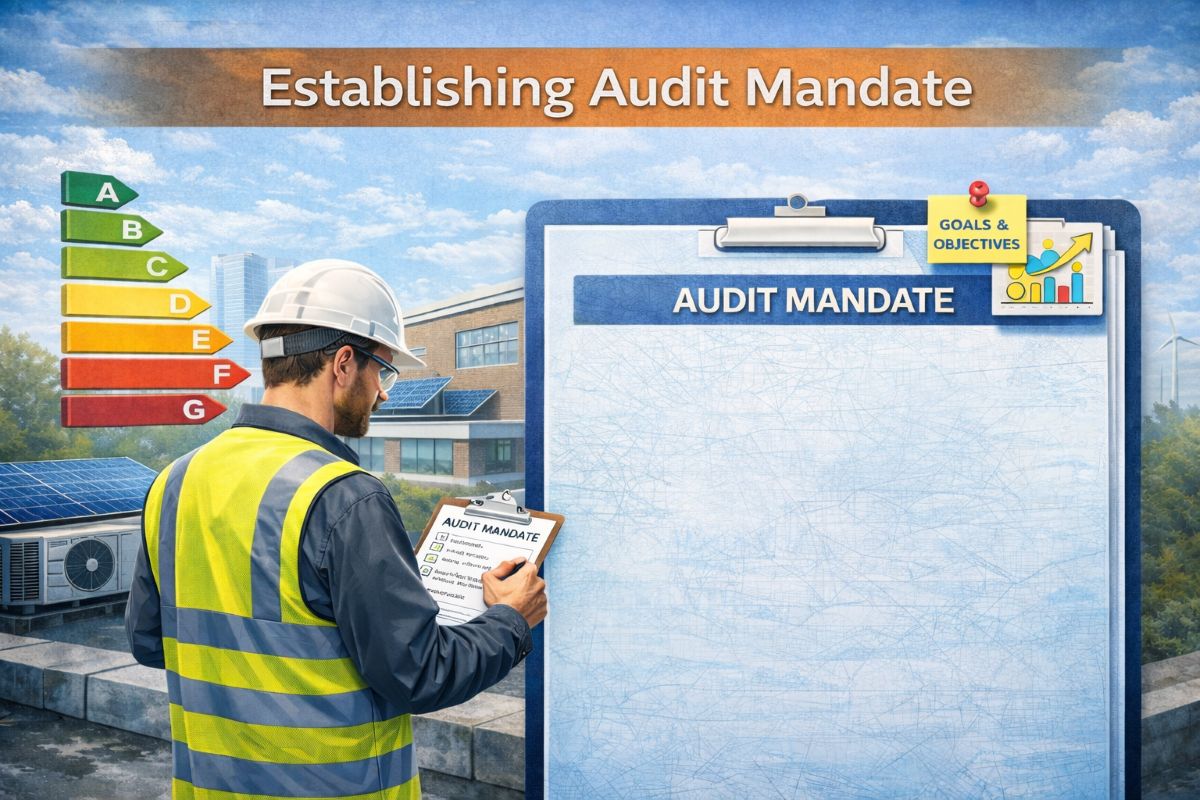
Establishing the Audit Mandate ! An energy audit should never begin as a casual instruction like “go and check where energy is being wasted.” A strong audit begins with a clear mandate that defines why the audit is being done, who has authorized it, what the expected outcomes are, and how far the audit team is empowered to go.
In formal audit methodology, the step after the initial condition survey is to establish the audit mandate so the work moves from observation into authorized and goal-driven action. Without this step, even a technically capable audit team can end up collecting too much data in the wrong areas, missing critical systems, or producing a report that management never fully owns.
That is why the audit mandate matters so much. It gives the audit purpose, direction, authority, and seriousness before deeper analysis begins.
🎯 What the Audit Mandate Really Means
The audit mandate is the formal statement that tells the organization and the audit team what this energy audit is expected to achieve. It is not just permission to inspect equipment; it is management’s instruction to investigate energy use in a structured way and identify opportunities for improvement.
A proper mandate usually answers some basic but powerful questions:
Why is the audit being conducted?
Which facility, plant, line, or utility systems are included?
Who is sponsoring the audit?
Who will support the audit team?
What level of detail is expected?
What kind of results should be delivered?
What timeline and resources are available?
When these questions are answered early, the audit becomes disciplined. When they are ignored, confusion enters from the very beginning.
🏭 Why Plants Often Struggle Without It
In many industries, energy is treated as an overhead cost rather than a managed process variable. When that mindset exists, audits are often launched weakly, with unclear targets, limited data support, poor cross-functional participation, and no fixed expectation from management.
This creates familiar problems. The maintenance team assumes the audit is only about equipment efficiency, the production team thinks it is only about utility cost reduction, the finance team wants fast savings numbers, and operators may see the audit as external interference rather than improvement support.
A clear mandate removes this confusion. It tells everyone that the audit is an authorized business activity with defined objectives and expected deliverables.
🧭 The Main Purpose of the Audit Mandate
The purpose of the audit mandate is to align people before measurements begin. A condition survey may show the physical state of the plant, but the mandate defines the business direction of the audit itself.
For example, one organization may launch an audit to cut utility costs by 10 percent. Another may want to improve energy performance for ISO 50001 readiness. Another may want to reduce specific steam consumption in a distillation unit or compressed air cost in a packaging section.
These goals are not the same, and the audit approach should not be the same either. That is why the mandate must convert general intention into a specific audit purpose.
📌 What Should Be Included
A good audit mandate should be practical, short, and unambiguous. It does not need to be a long policy note, but it must be clear enough that everyone understands what the audit team is expected to do.
A strong mandate normally includes:
The reason for the audit.
The plant, process, or facility covered.
The authority approving the work.
The audit leader or the responsible team.
Access rights to data, departments, and equipment.
Expected outputs such as findings, savings opportunities, and recommendations.
Timeline for completion.
Support is required from production, maintenance, utilities, finance, and management.
This matters because audit quality depends not only on engineering knowledge, but also on organizational access. If the audit team cannot get utility bills, log sheets, load data, operating schedules, and field cooperation, the final report will always be weaker than it should be.
👥 Management Commitment Comes First
No energy audit becomes effective unless management genuinely supports it. Energy audit frameworks consistently begin with preparation and organized planning, which means the audit must be backed by leadership and not treated as an informal side activity.
Management commitment is important for several reasons:
It gives the audit legitimacy.
It opens access to records and plant personnel.
It allows coordination across departments.
It signals that recommendations will be taken seriously.
It improves the chances of implementation after the report is submitted.
This is especially true in industrial plants where energy flows across many departments. Boilers, compressors, electrical systems, HVAC, pumps, production lines, furnaces, and utility distribution networks may belong to different teams, but the audit mandate brings them under one common objective.
🛠️ The Mandate Sets Boundaries
One of the biggest benefits of a good mandate is that it prevents the audit from becoming vague or endless. Many audits lose momentum because nobody defines what is inside the assignment and what is outside it.
For instance, is the audit limited to electrical energy, or does it also cover fuel, steam, compressed air, chilled water, and thermal losses? Is it only for one production block, or for the full plant? Is the focus only on low-cost improvements, or are capital projects also expected?
These limits must be known at the start. Once the mandate is clear, the later step of setting audit scope becomes easier, sharper, and more realistic.
📊 It Also Defines the Deliverables
A common reason audits disappoint management is that the expected output was never clearly defined. One group expects a short checklist, another expects a technical report with calculations, and another expects investment-grade recommendations with payback analysis.
The mandate should avoid that mismatch by stating what the audit team must finally deliver. Typical outputs may include:
Baseline understanding of energy use.
System-wise loss identification.
List of energy management opportunities.
Estimated savings.
Technical improvement options.
Economic evaluation and payback.
Priority ranking for implementation.
Action plan for monitoring and follow-up.
When deliverables are defined early, the audit team can collect the right depth of data. That makes the final report more useful and more credible.
⏱️ Time and Resources Must Be Clear
An audit mandate should never ignore time, manpower, and logistical support. A plant-wide audit cannot be completed effectively if the team is given only a few days, limited records, and no access to responsible personnel.
The mandate should therefore state the expected schedule, the available internal support, and the type of resources that may be needed, such as plant escorts, maintenance history, process data, metering access, and utility information.
This is not bureaucracy. It is practical planning. If resources are unclear, the audit becomes delayed, incomplete, or dependent on guesswork.
🔍 A Good Mandate Improves Data Quality
One of the hidden strengths of the audit mandate is that it improves the quality of information collected later. When departments know that the audit has formal backing, they are more likely to share authentic records, production details, operating hours, maintenance issues, and known system problems.
That honesty is valuable. Energy losses are rarely visible from bills alone. The real story often lies in production schedules, bypass practices, manual operations, partial loading, poor control philosophy, uncalibrated meters, and long-standing field habits.
A formal mandate gives the audit team the confidence to ask deeper questions and gives site teams the confidence to cooperate openly. That improves both technical analysis and final recommendations.
⚠️ What Happens When the Mandate Is Weak
A weak or missing mandate creates predictable problems. The audit may begin with energy enthusiasm, but soon falls into confusion because nobody agrees on the purpose, the level of detail, or the ownership of the action.
Typical failures include:
No clear audit objective.
Poor participation from departments.
Delayed access to bills and processing data.
Repeated arguments about plant boundaries.
No agreement on what counts as a recommendation.
Recommendations that are technically correct but not organizationally supported.
This is why experienced auditors know that the first management-level steps are just as important as field measurements. Engineering without organizational clarity often produces elegant reports with little implementation value.
💡 Turning Intent Into Action
An energy audit becomes meaningful only when intention is translated into action. The mandate is the step where management says, in effect, “We are not merely curious about energy use; we are committed to understanding it and improving it.
That single shift changes the tone of the entire exercise. The audit is no longer a general inspection. It becomes a focused performance improvement effort linked to cost, efficiency, sustainability, and operational discipline.
This is especially relevant for plants pursuing structured energy management practices. Standard audit methods treat the early audit stages as organized preparation, not random investigation, because strong preparation increases the value of every later step.
🏗️ Practical Example from Industry
Imagine a chemical plant where power consumption is rising, steam losses are suspected, and compressed air demand has increased over the last year. If management simply says, “Do an energy audit,” the audit team may inspect many areas but produce a scattered report.
Now imagine the same plant issues a proper audit mandate: the audit will cover utility generation and major process users, focus on steam, power, and compressed air, identify operational and capital-saving opportunities, involve production and maintenance departments, and submit a prioritized action plan within six weeks.
Immediately, the audit becomes sharper. The data required becomes clear, the team structure becomes clear, the expectation becomes clear, and the value of the final report rises dramatically.
📝 What the Auditor Should Confirm Early
Before moving fully into the next stages, the auditor should verify that the mandate is not merely verbal and vague. It should be understood by all key stakeholders and reflected in how the audit is being supported.
A practical checklist for this stage can include:
Has top management approved the audit?
Is the objective clearly stated?
Are plant boundaries identified?
Are the responsible departments informed?
Is access to data confirmed?
Are expected outputs defined?
Is the timeline realistic?
Is there agreement on who will review the findings?
These checks save time later. They reduce misunderstanding and build professionalism into the audit from day one.
🌱 The Foundation for Everything Next
The audit mandate may look like an administrative step, but in reality, it is one of the most strategic parts of the entire audit process. It connects management intent, technical investigation, and implementation potential into one structured beginning.
Once the mandate is established, the audit can move confidently into scope definition, data analysis, system investigation, opportunity identification, and economic evaluation. Without it, the audit risks becoming fragmented, reactive, and weak.
So before measuring load, checking steam traps, logging compressor cycles, or calculating payback, establish the audit mandate properly. 📘 It gives the audit authority clarity, direction, and the organizational strength required to turn findings into real energy performance improvement.
✨closing lines
The best energy audits do not begin with instruments alone — they begin with clear intent, strong authorization, and a serious commitment to improvement.
When the mandate is clear, the audit gains purpose. When the purpose is clear, the results become powerful.