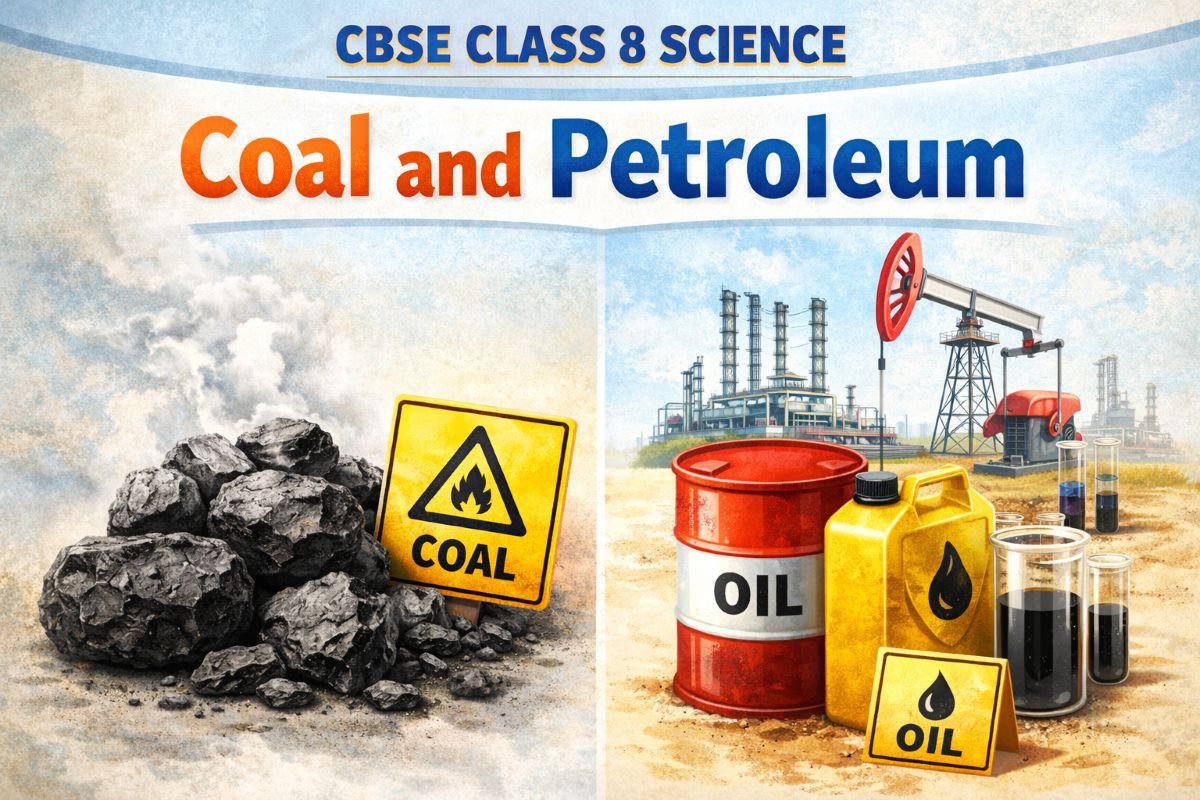
CBSE Class 8 Science Chapter Coal and Petroleum
CBSE Class 8 Science CHAPTER
⛏️ Coal and Petroleum
Complete Chapter Notes · Tables · Quick Revision · Quiz · Worksheets
📊 9 Tables
🎯 Quick Revision
❓ 15-Q Quiz
📝 5 Worksheets
📋 Table of Contents
- Introduction — Natural Resources
- Coal — Formation, Types & Products
- Petroleum — Formation & Refining
- Fractions of Petroleum — Complete Table
- Natural Gas — CNG & LPG
- Petrochemicals & Their Uses
- Environmental Impact & Conservation
- ⚡ Quick Revision — Key Terms & Formulas
- ❓ Quiz (15 MCQs with Answers)
- 📝 Worksheets (5 Types × 10 Questions)
📖 1. Introduction — Natural Resources
All things present in nature that are useful to humans are called Natural Resources. Some resources are available in unlimited quantities; others are finite and can be exhausted. Coal, Petroleum, and Natural Gas are precious natural resources called Fossil Fuels — they power our entire modern civilisation.
🌍 Types of Natural Resources
| Type | Definition | Examples |
|---|---|---|
| ♾️ Inexhaustible | Present in unlimited quantity; not depleted by use | Sunlight, Air, Wind, Water |
| ⚠️ Exhaustible | Present in limited quantity; can be used up | Coal, Petroleum, Natural Gas, Forests, Wildlife |
⛏️ 2. Coal
🔎 2.1 What is Coal?
- 🖤 Coal is a hard, black, combustible mineral found beneath the Earth’s surface.
- 🖤 It is the most abundant fossil fuel found in India.
- 🖤 Coal was formed from the remains of trees and plants that lived hundreds of millions of years ago.
- 🖤 Coal is a major source of energy for electricity generation in India.
🌿 2.2 Formation of Coal — Carbonisation
- 🟢 About 300 million years ago, dense forests existed in low-lying wetland areas.
- 🟢 These forests were submerged under water due to natural calamities (earthquakes, floods).
- 🟢 Plant material was covered by layers of sediment (soil, mud, rock).
- 🟢 Over millions of years, high heat and pressure converted organic matter into coal.
- 🟢 Coal is a carbon-rich substance — hence the process is called Carbonisation.
📊 2.3 Types of Coal — Quality Grades
| Type | Carbon % | Quality | Uses |
|---|---|---|---|
| Peat | ~60% | ⭐ Lowest; high moisture | Fuel in some regions; beginning stage |
| Lignite | ~70% | ⭐⭐ Low grade; brown colour | Thermal power stations |
| Bituminous | 75–85% | ⭐⭐⭐ Medium; most common | Steam engines, power plants, coke production |
| Anthracite | 90–95% | ⭐⭐⭐⭐ Highest; hard and shiny | Domestic heating, high-temperature industrial fuel |
🏭 2.4 Products Obtained from Coal (Destructive Distillation)
| Product | What It Is | Important Uses |
|---|---|---|
| 🔥 Coke | Hard, grey, porous; nearly pure carbon | Iron & steel industry (smelting); industrial fuel |
| 🖤 Coal Tar | Black thick liquid; mixture of 200+ substances | Dyes, drugs, explosives, perfumes, plastics, road surfacing |
| 💨 Coal Gas | Mix of H₂, CH₄, CO released during heating | Industrial fuel; formerly used for street lighting (London) |
| 🌱 Ammonia | NH₃; from ammoniacal liquor residue | Fertilizers (ammonium sulphate, urea), cleaning agents |
🗺️ 2.5 Major Coalfields in India
- 🟣 Jharia, Jharkhand — Largest and most important coalfield in India
- 🟣 Raniganj, West Bengal — One of the oldest coalfields
- 🟣 Singrauli, Madhya Pradesh — Major coal reserve
- 🟣 Talcher, Odisha and Korba, Chhattisgarh — Significant reserves
🛢️ 3. Petroleum
🔎 3.1 What is Petroleum?
- 🟤 Petroleum is a dark, oily liquid with an unpleasant smell.
- 🟤 The word comes from Latin: Petra (rock) + Oleum (oil) = Rock Oil.
- 🟤 Found trapped between rock layers beneath the Earth’s surface and under the seabed.
- 🟤 It is a mixture of hydrocarbons (compounds of hydrogen and carbon).
- 🟤 Often called “Black Gold” due to its immense economic value.
🌊 3.2 Formation of Petroleum
- 🔵 Millions of years ago, tiny sea organisms died and settled at the sea bottom.
- 🔵 Their remains were covered by layers of sand and silt.
- 🔵 Heat, pressure, and bacterial action over millions of years converted them into petroleum.
- 🔵 Petroleum collected in porous rock layers trapped between non-porous rocks.
- 🔵 Natural gas (lighter) floats above petroleum; salt water (heavier) lies below.
🔬 3.3 Refining of Petroleum — Fractional Distillation
- 🟣 Crude oil is heated in a furnace and vapours pass into a tall fractionating column.
- 🟣 The column is HOT at the bottom and COOL at the top.
- 🟣 Different components condense at different heights based on their boiling points.
📊 4. Fractions of Petroleum — Complete Table
| Fraction | Boiling Range | Form | Main Uses |
|---|---|---|---|
| 🟢 LPG | Below 30°C | Gas | Cooking fuel, petrochemical feedstock |
| ⚡ Petrol | 30–110°C | Colourless liquid | Motor fuel for cars, motorcycles; dry cleaning |
| 🧪 Naphtha | 70–120°C | Light liquid | Making chemicals, solvents, petrochemicals |
| ✈️ Kerosene | 150–250°C | Pale yellow liquid | Jet fuel (ATF), stoves, lamps, heating |
| 🚌 Diesel | 250–350°C | Oily liquid | Trucks, buses, trains, pumps, generators |
| 🚢 Fuel Oil | 350–400°C | Dark viscous liquid | Ship fuel, industrial furnaces, power plants |
| ⚙️ Lubricating Oil | Above 400°C | Viscous liquid | Lubricating machine parts, motors, engines |
| 🕯️ Paraffin Wax | Solid residue | White solid | Candles, Vaseline, ointments, wax polish |
| 🛣️ Bitumen | Final residue | Black solid | Road surfacing (tar roads), waterproofing |
🗺️ 3.4 Major Oil Fields in India
| Oil Field / Refinery | Location | Remarks |
|---|---|---|
| Mumbai High | Offshore, Maharashtra | 🏆 Largest; produces ~50% of India’s crude oil |
| Digboi | Assam | 🥇 Oldest oil field & refinery in India (since 1901) |
| Ankleshwar | Gujarat | Major onshore oil field |
| Barmer | Rajasthan | Significant newer oil discovery |
| Krishna-Godavari Basin | Andhra Pradesh / Telangana | Important gas field (Reliance KG-D6) |
💨 5. Natural Gas — CNG & LPG
- 🔵 Natural gas is found above petroleum in rock traps beneath the Earth’s surface.
- 🔵 It is primarily Methane (CH₄) with small amounts of ethane, propane, and butane.
- 🔵 When compressed under high pressure, it becomes CNG (Compressed Natural Gas).
| Fuel | Full Form | Composition | Key Advantages |
|---|---|---|---|
| CNG | Compressed Natural Gas | Mainly CH₄ | Clean fuel; low emissions; used in vehicles (autos/buses); piped to homes |
| LPG | Liquefied Petroleum Gas | Propane + Butane | Cooking fuel; clean burning; no smoke; easy storage in cylinders |
📊 Coal vs Petroleum vs Natural Gas — Big Comparison
| Property | ⛏️ Coal | 🛢️ Petroleum | 💨 Natural Gas |
|---|---|---|---|
| Origin | Ancient plant matter | Marine organisms | Formed with petroleum |
| Physical State | Solid | Liquid | Gas |
| Main Component | Carbon (C) | Hydrocarbons (C+H) | Methane (CH₄) |
| How Obtained | Mining | Drilling + pumping | Drilling; piped |
| Major Use | Electricity generation | Transport fuels | Cooking, vehicles |
| Clean Burning? | ❌ Most polluting | ⚠️ Moderate | ✅ Cleanest |
| India Reserves | Abundant | Limited | Moderate |
🧪 6. Petrochemicals & Their Uses
Petroleum and natural gas are not just fuels — they are raw materials for making thousands of useful products called petrochemicals.
| Petrochemical | Source | Products Made |
|---|---|---|
| Ethylene | Petroleum cracking | Polyethylene plastic, antifreeze, PVC |
| Propylene | Petroleum | Polypropylene plastic, synthetic rubber |
| Benzene | Petroleum / Coal Tar | Drugs, dyes, detergents, plastics, nylon |
| Ammonia | Natural Gas | Fertilizers, cleaning agents, refrigeration |
| Synthetic Rubber | Petroleum | Tyres, seals, waterproof clothing, footwear |
| Synthetic Fibres | Petroleum / Coal Tar | Nylon, polyester, acrylic clothing & textiles |
⚠️ 7. Environmental Impact & Conservation
🌍 7.1 Environmental Damage from Fossil Fuels
- 🔴 Global Warming: Burning fossil fuels releases CO₂ which traps heat → rising Earth temperatures.
- 🔴 Acid Rain: Coal releases SO₂ and NOₓ → react with water vapour → sulphuric & nitric acid → damages crops, buildings, ecosystems.
- 🔴 Air Pollution: Soot and particulate matter cause respiratory diseases, smog, and haze.
- 🔴 Water Pollution: Oil spills during transport harm marine life and contaminate water bodies.
- 🔴 Land Degradation: Coal mining causes deforestation, soil erosion, and habitat destruction.
♻️ 7.2 Conservation of Fossil Fuels
| Conservation Method | How It Helps |
|---|---|
| 🚌 Use public transport / carpool | Reduces petrol/diesel consumption per person significantly |
| ☀️ Switch to renewable energy | Solar, wind, and hydro energy reduce dependence on fossil fuels |
| 💡 Use energy-efficient appliances | LED bulbs, 5-star appliances reduce electricity demand from coal plants |
| 🚲 Walk / cycle for short distances | Zero fossil fuel consumption; also improves health |
| 🔌 Turn off unused appliances | Saves electricity generated from coal-fired thermal plants |
| 🔬 Research alternative fuels | Hydrogen, biofuels, and electric vehicles as long-term replacements |
⚡ 8. QUICK REVISION — Key Points
⛏️ COAL at a Glance
Formed from → ancient plants
Process → Carbonisation
Types → Peat < Lignite < Bituminous < Anthracite
Products → Coke, Coal Tar, Coal Gas, Ammonia
Largest field → Jharia, Jharkhand
🛢️ PETROLEUM at a Glance
Formed from → marine organisms
Process → Fractional Distillation
Fractions → LPG, Petrol, Kerosene, Diesel, Bitumen
Largest field → Mumbai High
Oldest field → Digboi, Assam
💨 NATURAL GAS at a Glance
Main component → Methane CH₄
CNG → Compressed Natural Gas
LPG → Propane + Butane
Cleanest fossil fuel
Used in vehicles & cooking
🔑 Key Terms — Quick Glossary
| Term | Definition |
|---|---|
| Fossil Fuels | Fuels formed from ancient organisms buried under Earth — Coal, Petroleum, Natural Gas |
| Carbonisation | Conversion of dead plant material into coal over millions of years under heat and pressure |
| Fractional Distillation | Separation of crude petroleum into fractions based on different boiling points |
| Coke | Nearly pure carbon; hard grey solid from coal; used in iron and steel industry |
| Coal Tar | Black thick liquid from coal; source of 200+ chemicals including naphthalene |
| Petroleum | Dark oily liquid; Petra (rock) + Oleum (oil); found between rock layers |
| Bitumen | Black solid residue of petroleum; used in road surfacing (tar roads) |
| CNG | Compressed Natural Gas; mainly methane; cleanest fossil fuel; used in vehicles |
| LPG | Liquefied Petroleum Gas; propane + butane; used for cooking |
| Global Warming | Rise in Earth’s temperature due to excess CO₂ from burning fossil fuels |
| Acid Rain | Rainfall mixed with sulphuric/nitric acids from SO₂ and NOₓ released by burning coal |
| Petrochemicals | Chemicals derived from petroleum/gas used in making plastics, fertilizers, drugs, fibres |
❓ 9. Quiz — 15 Multiple Choice Questions
📝 Try answering before looking at the answer!
Q1. Fossil fuels are formed from:
A) Living plants B) Ancient organisms buried for millions of years C) Chemical reactions in labs D) Volcanic activity
Q2. The process by which dead plant matter is converted into coal is called:
A) Fossilisation B) Fractional Distillation C) Carbonisation D) Combustion
Q3. Which type of coal has the highest carbon content?
A) Peat B) Lignite C) Bituminous D) Anthracite
Q4. Coke is mainly used in:
A) Cooking B) The iron and steel industry C) Making medicines D) Running vehicles
Q5. Naphthalene balls (used to repel insects) are obtained from:
A) Petroleum B) Coal Gas C) Coal Tar D) Natural Gas
Q6. Which fraction of petroleum is used as jet fuel?
A) Petrol B) Kerosene C) Diesel D) Bitumen
Q7. The word ‘Petroleum’ is derived from:
A) Greek words for fire and oil B) Latin: Petra (rock) + Oleum (oil) C) Arabic words for black and liquid D) Sanskrit words for earth and water
Q8. What is the main component of Natural Gas?
A) Ethane B) Propane C) Butane D) Methane (CH₄)
Q9. Which is the largest offshore oil field in India?
A) Digboi B) Ankleshwar C) Mumbai High D) Barmer
Q10. Bitumen obtained from petroleum is mainly used for:
A) Cooking fuel B) Road surfacing C) Making medicine D) Lubricating engines
Q11. Which fossil fuel is considered the cleanest?
A) Coal B) Lignite C) Petroleum D) Natural Gas (CNG)
Q12. The separation of petroleum into its components is done by:
A) Carbonisation B) Fractional Distillation C) Evaporation D) Crystallisation
Q13. Coal Gas was formerly used for:
A) Cooking food B) Street lighting C) Powering aircraft D) Making plastic
Q14. LPG is a mixture of:
A) Methane and Ethane B) Propane and Butane C) Hydrogen and Oxygen D) CO and CO₂
Q15. Fossil fuels are classified as exhaustible because:
A) They are very expensive B) They produce pollution C) They take millions of years to form and cannot be quickly replaced D) Found in few countries
📝 10. Worksheets — 5 Types × 10 Questions Each
📋 Worksheet 1: Fill in the Blanks
Instructions: Fill in the blanks with the correct word/term.
- Coal, Petroleum, and Natural Gas are called ___________ fuels.Ans: Fossil
- The process by which dead plant material is converted into coal is called ___________.Ans: Carbonisation
- ___________ type of coal has the highest carbon content and is the best quality.Ans: Anthracite
- The separation of crude oil into useful fractions at a refinery is done by ___________.Ans: Fractional Distillation
- CNG stands for ___________ and is mainly composed of ___________.Ans: Compressed Natural Gas; Methane (CH₄)
- The black thick liquid obtained from coal containing 200+ substances is called ___________.Ans: Coal Tar
- ___________ is the residue of petroleum distillation used for road surfacing.Ans: Bitumen (Asphalt)
- LPG is a mixture of ___________ and ___________ gases.Ans: Propane and Butane
- The oldest oil field in India is located at ___________ in Assam.Ans: Digboi
- Coal and petroleum are ___________ natural resources as they cannot be replenished quickly.Ans: Exhaustible
✅ Worksheet 2: True or False
Instructions: Write True or False for each statement.
- Coal was formed from ancient marine organisms.❌ False — Coal formed from ancient land plants. Petroleum formed from marine organisms.
- Anthracite is the lowest quality coal.❌ False — Peat is the lowest quality. Anthracite has the highest carbon content and quality.
- Coke is used in the iron and steel industry.✅ True — Coke acts as a reducing agent in blast furnaces to extract iron from iron ore.
- Kerosene is used as jet fuel.✅ True — Refined kerosene (ATF — Aviation Turbine Fuel) powers jet aircraft engines.
- Natural gas is found below petroleum under the Earth’s surface.❌ False — Natural gas is LIGHTER and floats ABOVE petroleum in the rock trap.
- Bitumen is used for road surfacing.✅ True — Bitumen (asphalt), the black solid residue of petroleum, is used to tar roads.
- CNG is the cleanest burning fossil fuel available.✅ True — CNG burns most cleanly with least pollution among all fossil fuels.
- Mumbai High is the largest coalfield in India.❌ False — Mumbai High is India’s largest PETROLEUM field. Largest coalfield is Jharia, Jharkhand.
- Coal tar is used to make medicines, dyes, and explosives.✅ True — Coal tar is a source of 200+ chemicals including drugs, dyes, TNT explosives.
- Burning fossil fuels contributes to global warming.✅ True — Burning fossil fuels releases CO₂ which traps heat in the atmosphere causing global warming.
📖 Worksheet 3: Short Answer Questions
Instructions: Answer each question in 2–3 sentences.
- What is carbonisation? How does coal form?Ans: Carbonisation is the process by which dead plant matter is slowly converted into coal over millions of years under high heat and pressure. Ancient forests were submerged under water, covered by sediment, and over time the organic matter transformed into coal — a carbon-rich solid fuel.
- What is fractional distillation? Why is it used for petroleum?Ans: Fractional distillation separates a mixture of liquids by heating them and collecting vapours that condense at different temperatures. It is used for crude petroleum because it is a complex mixture of many hydrocarbons — each fraction (petrol, kerosene, diesel etc.) has a different boiling point and condenses at a different height in the fractionating column.
- Name four products obtained from coal and their uses.Ans: (1) Coke — used in iron and steel industry. (2) Coal Tar — source of 200+ chemicals including dyes, drugs, and naphthalene. (3) Coal Gas — used as industrial fuel. (4) Ammonia — used in making fertilizers.
- What is the difference between CNG and LPG?Ans: CNG (Compressed Natural Gas) is mainly methane (CH₄), compressed under high pressure, and used primarily in vehicles and industries. LPG (Liquefied Petroleum Gas) is a mixture of propane and butane, stored as liquid in cylinders, and used primarily as cooking fuel. Both are cleaner than coal.
- Why are coal and petroleum called exhaustible resources?Ans: Coal and petroleum took millions of years to form from ancient organisms under extreme heat and pressure. Once consumed, they cannot be replenished within a human lifetime. Since our rate of consumption is far greater than the rate of formation, they are classified as exhaustible (non-renewable) resources.
- Name four fractions from petroleum and their uses.Ans: (1) Petrol — fuel for cars and motorcycles. (2) Kerosene — jet fuel and cooking stoves. (3) Diesel — fuel for trucks, buses, and trains. (4) Bitumen — road surfacing and waterproofing.
- How does burning fossil fuels cause acid rain?Ans: When coal and petroleum are burned, they release sulphur dioxide (SO₂) and nitrogen oxides (NOₓ). These gases react with water vapour in the atmosphere to form sulphuric and nitric acids, which fall as acid rain. Acid rain damages forests, crops, buildings, and aquatic ecosystems.
- What is coke? How is it obtained from coal?Ans: Coke is nearly pure carbon — a hard, grey, porous solid obtained by heating coal strongly in the absence of air (destructive distillation). It has a very high carbon content, burns at high temperature, and is used as a reducing agent in blast furnaces to smelt iron ore into iron for the steel industry.
- List four ways to conserve fossil fuels.Ans: (1) Use public transport or carpool to reduce petrol/diesel consumption. (2) Switch to renewable energy sources (solar, wind) for electricity. (3) Use energy-efficient appliances (LED bulbs, 5-star ratings). (4) Use CNG or LPG instead of coal as they burn more efficiently and cause less pollution.
- Why is natural gas called the cleanest fossil fuel?Ans: Natural gas is primarily methane (CH₄). When burned, it produces only carbon dioxide and water — much less CO₂ per unit of energy compared to coal or petrol. It produces virtually no SO₂, almost no particulate matter, and minimal nitrogen oxides, making it by far the cleanest burning fossil fuel.
🔗 Worksheet 4: Match the Following
Instructions: Match Column A with the correct option from Column B.
| Column A | Column B |
|---|---|
| 1. Carbonisation | a. Mainly methane; used in vehicles |
| 2. Bitumen | b. Conversion of plants to coal over millions of years |
| 3. CNG | c. Used in iron and steel making |
| 4. Coke | d. Road surfacing material from petroleum |
| 5. Coal Tar | e. Oldest oil refinery in India |
| 6. Digboi | f. Source of naphthalene and over 200 chemicals |
| 7. Anthracite | g. Highest quality coal |
| 8. Petrol | h. Fuel for cars and motorcycles |
| 9. Mumbai High | i. Largest offshore oil field in India |
| 10. Fractional Distillation | j. Separation of crude oil into useful fractions |
🤔 Worksheet 5: Give Reasons
Instructions: Explain the reason for each observation in 2–3 sentences.
- Fossil fuels should be used judiciously.Reason: Fossil fuels are exhaustible and took millions of years to form. Once consumed, they cannot be replaced in a human lifetime. Wasteful use depletes them rapidly, threatens future energy security, and causes serious environmental pollution including global warming and acid rain.
- CNG is preferred over petrol and diesel in vehicles.Reason: CNG burns much more cleanly than petrol or diesel, producing significantly less CO₂, virtually no SO₂, and minimal particulate matter. This reduces air pollution in cities. CNG is also cheaper per kilometre. Delhi mandated CNG in all public transport to combat severe smog.
- Coal tar is considered a very valuable industrial material.Reason: Coal tar is a complex mixture from which over 200 different substances can be extracted, including dyes, drugs (aspirin), explosives (TNT), perfumes, paints, waterproofing agents, and naphthalene. Its enormous range of industrial applications makes it extremely valuable despite being a by-product.
- Petroleum is also called ‘Black Gold’.Reason: Petroleum is black in colour and immensely valuable. It powers all vehicles and industries worldwide, and provides raw materials for thousands of products including plastics, medicines, fertilizers, and synthetic fibres. Like gold, it is precious, limited in supply, and drives global economies.
- Natural gas is found above petroleum in underground reserves.Reason: Natural gas is mainly methane (CH₄), which has a very low molecular weight and density compared to liquid petroleum. Being much lighter, it naturally rises and accumulates above the petroleum layer in the rock trap. This is why natural gas is often encountered first when drilling for oil.
- Lignite is not preferred over anthracite as a fuel.Reason: Lignite has a lower carbon content (~70%) and higher moisture content compared to anthracite (~90–95% carbon). It produces less heat per unit mass, generates more smoke and ash, and is less efficient. Anthracite burns hotter, cleaner, and more efficiently, making it the preferred industrial fuel.
- Oil wells do not need pumps when first drilled.Reason: When an oil well is first drilled, petroleum underground is under immense natural pressure from compressed natural gas trapped above it. This pressure is sufficient to push petroleum up the drill pipe to the surface without pumps. Only after pressure reduces does artificial pumping become necessary.
- Burning coal is more harmful to the environment than burning natural gas.Reason: Coal contains sulphur, nitrogen compounds, and ash along with carbon. Burning coal releases large amounts of CO₂, SO₂, NOₓ, and particulate matter (soot), causing global warming, acid rain, and severe air pollution. Natural gas (methane) burns cleanly, releasing only CO₂ and water with negligible other pollutants.
- Naphthalene balls are a product of coal, not petroleum.Reason: Naphthalene balls are obtained from Coal Tar, not petroleum. Coal tar is produced during the destructive distillation of coal. It is a complex mixture from which over 200 substances including naphthalene (C₁₀H₈) are extracted. Naphthalene sublimes slowly at room temperature, releasing vapours that repel moths and insects.
- We should switch to renewable sources of energy.Reason: Fossil fuels are finite — they will eventually run out — and cause serious environmental damage including global warming, acid rain, and air pollution. Renewable energy sources like solar, wind, and hydroelectric energy are inexhaustible, produce no harmful emissions, are sustainable, and ensure long-term energy security for future generations.
🌟 Chapter Summary — Coal & Petroleum
⛏️ Coal
Plants → Carbonisation → Peat→Lignite→Bituminous→Anthracite | Products: Coke, Coal Tar, Gas, Ammonia
🛢️ Petroleum
Marine organisms → Fractional Distillation → LPG, Petrol, Kerosene, Diesel, Wax, Bitumen
💨 Natural Gas
CH₄ (Methane) | CNG = cleanest | LPG = propane + butane | Used in vehicles & cooking
♻️ Conservation
Public transport · Renewable energy · LED bulbs · CNG over coal · Walk/cycle
CBSE Class 8 Science | Chapter: Coal and Petroleum